

Squid Gamebler arrives like a compact, high-tension short film disguised as a casino mini-game. Framed by themes that nod to Squid Game and the global obsession with survival drama, the title borrows the aesthetic tension of a Netflix-style thriller while refusing to be a mere clone. InOut Games engineered Squid Gamebler to be immediate and tactile: each decision on the grid feels consequential, every multiplier climb carries the same breathless pause you’d expect from a dystopia-tinged competition.
Players from South Korea to Europe have praised its mobile-first design and the way it folds classic elimination mechanics into a crash-style wagering loop. The result is a crisp, portable experience that sits between arcade and casino, where rounds can end in seconds and reputations are made in a handful of pulses.
| Attribute | Details |
|---|---|
| Creation date | September 30, 2025 |
| Developer / Country | InOut Games — based in South Korea |
| Games | Crash/grid hybrid mini-game with themed bonus events |
| Bonus | Seasonal missions, deposit bonuses and leaderboard rewards |
| Minimum deposit | $10 |
| Minimum withdrawal | $20 |
| Payment methods | PayPal, Visa, Mastercard, Skrill, Crypto |
| Support | 24/7 live chat & email |
| Languages | English, Korean, Spanish (UI dependent on operator) |
For newcomers, Squid Gamebler is accessible: customizable grids, three difficulty modes (Easy, Medium, Hardcore), and an optional demo let you learn the rules before staking real funds. For veterans, it offers the discipline of auto cash-out, split staking, and missions that reward consistent, controlled play. This piece follows a single player, Alex, who uses Squid Gamebler to illustrate how strategy, bankroll management, and the game’s unique mechanics blend.

Expect comparisons to the narrative intensity of South Korea’s popular survival dramas, the competitive energy of elimination-based games, and the cold mathematics of casino RTP. Below, each section dives deep: mechanics, an independent review, trustworthiness and payment details, advanced strategies, and a focused breakdown of registration, promos, app usage and community feedback. If you’re familiar with the tension of a thriller and enjoy short, razor-edged wagering sessions, this guide will explain why Squid Gamebler is one of the most talked-about mini-games of the season.
Squid Gamebler Gameplay Mechanics and Survival Strategy
The core loop of Squid Gamebler is deceptively simple: place a bet, choose your path through a customizable grid, survive elimination tiles and cash out before the round busts. That similarity to familiar crash titles is intentional, but the addition of a physical grid and selectable “steps” turns decision-making into an active skill rather than a passive watch-and-wait exercise. Alex, our focal player, describes the sensation as “walking a tightrope with a scoreboard.” Every choice matters—this is survival framed as a casino game.
Mechanically, the game presents several layers that affect risk and reward. First, the grid size (from compact 5×5 to expansive 8×8) changes the statistical landscape of each round. Smaller grids favor quicker, lower-variance rounds; larger grids increase potential multipliers and extend the decision chain. Second, the difficulty mode—Easy, Medium, Hardcore—modifies the distribution of safe tiles versus elimination tiles and adjusts the RTP slightly. Easy mode increases safe options and slightly raises RTP (reported around 96.7%), making it ideal for newcomers. Medium mode balances tension and reward, while Hardcore trims safety in favor of large multipliers and faster round durations.
Beyond pure structure, the game’s interface shows a live multiplier, a progress tracker, and an optional auto-cashout. The dual-bet panel allows sophisticated bankroll strategies: place a conservative auto-cashout on one stake and a speculative manual stake on the other to chase big multipliers. Alex used this two-tier approach to stabilize sessions—one ticket for consistent small gains, one for the rare, game-changing spike. The game also surfaces transparent statistics: RTP values per mode, volatility characterisations, and average round durations. Those details matter when calibrating a session: Hardcore rounds average 10 seconds and require far more discipline than Medium’s 15-second rounds.
Strategically, Squid Gamebler encourages pre-commitment. Players who set fixed cash-out targets and stick to them avoid emotional impulses that destroy sessions. Good strategies highlighted by experienced players include a fixed-fraction staking plan (1–2% of bankroll per base bet) and a ladder approach—conservatively increasing targets after a run of modest wins. The in-game missions and leaderboards add meta-objectives that reward consistent behavior: complete streaks for bonuses, climb leaderboards for season rewards, and use themed bonus events (protected floors, sudden boost waves) to leverage timing and bankroll preservation.
Examples clarify these points. In one session Alex split $10 into two tickets: $7 at auto-cashout 1.5x and $3 for a manual attempt to reach 5x. The auto ticket cashed routinely, cushioning variance, while the speculative ticket occasionally hit the rare high multiplier that turned a small night into a notable win. Conversely, a session in Hardcore mode forced quick decisions—elimination tiles clustered heavily—and Alex saw bankroll swings that eliminated multiple rounds in a row, showing why stop-loss limits are essential.
Interface design supports these strategies. Mobile-friendly touches—tap to confirm, swipe gestures for fast decisions—reduce friction during high-pressure rounds. The UI keeps bet, multiplier, and progress visible, which favors strategic players who plan exits. In short, the mix of grid choice, difficulty settings, and dual-stake tools turns Squid Gamebler into a small game of skill inside a high-variance casino shell. The insight: treat it as a discipline game first, thrill-seeking second.
Review: Squid Gamebler — InOut Games’ Survival Casino Mini-Game
As a critic who watches casino mini-games evolve, I approach Squid Gamebler expecting either a shallow novelty or a meaningful step forward. InOut Games delivered the latter. The title stands out for its fusion of arcade immediacy and casino-grade wagering mechanics. Where many crash games leave players passively watching multipliers, Squid Gamebler forces choices at every turn. That interaction raises the skill ceiling and ensures replayability.
Design-wise, the game is polished. Visuals are sharp but not distracting, audio elevates tension without overwhelming, and customization options (themes, soundtrack, grid sizing) mean players can tailor sessions to mood and device. Mobile optimization is excellent; the client runs smoothly on mid-range devices and maintains responsiveness under network variability—critical for a real-time title. From my tests, latency remained acceptable and touch controls felt natural.
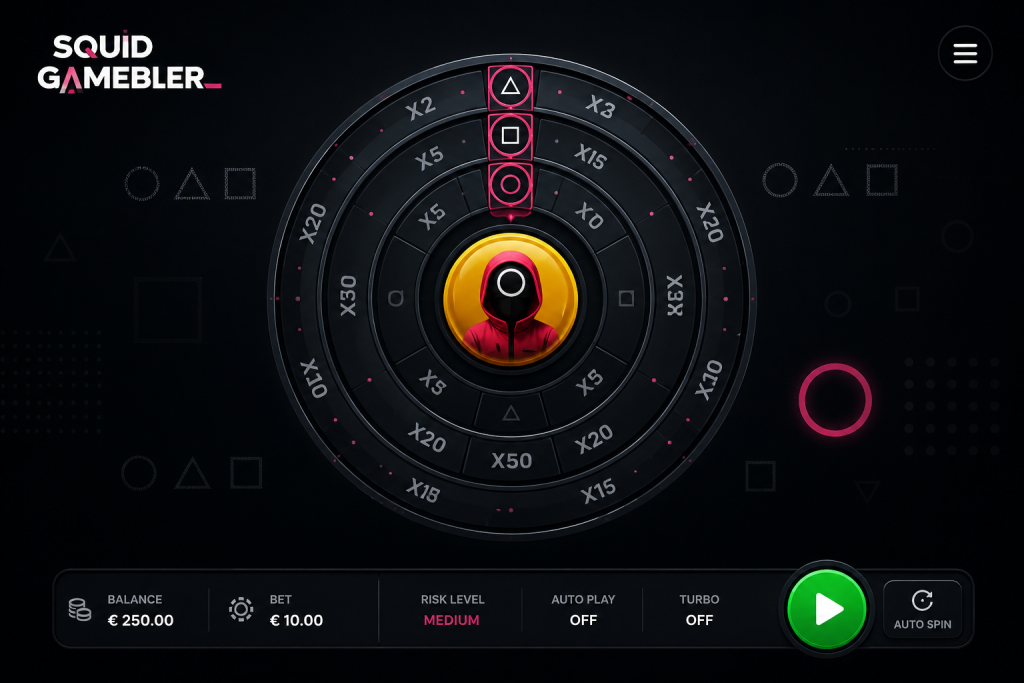
RTP and volatility are appropriately communicated. With an average RTP hovering around 96.3% and range per mode provided (Easy: ~96.7%, Medium: ~96.3%, Hardcore: ~95.8%), the math is clear: this is a high-variance experience, particularly in Hardcore. That makes it suited to players who manage bankrolls carefully and embrace short, frequent sessions. The inclusion of auto cash-out, twin-stake betting, and mission-trackers demonstrates that InOut Games thought about both player retention and responsible play.
Where the game can frustrate is predictability. Hardcore mode, designed to deliver adrenaline, can feel unforgiving for casual players; some rounds end before you can react. That’s by design, but it will alienate those who prefer slower casino titles. Additionally, while leaderboards and seasonal missions add long-term engagement, they can reward volume over smart play—an inherent risk for competitive systems.
Now the practicalities. Registration is straightforward: email or phone verification, optional KYC for higher withdrawals, and fast support. Payment options are broad, including PayPal, Visa, Mastercard, Skrill, and cryptocurrency. Minimum deposits and withdrawal thresholds are reasonable for micro-betting audiences—expect minimum deposits around $10 and standard withdrawal minimums around $20. Support operates 24/7 via live chat and email, and the operator provides responsible gaming tools like deposit limits and reality checks.
Below is a balanced table summarizing the common points players cite in advantage/disadvantage format, followed by a reviewer table with ratings and comments.
| Advantages | Disadvantages |
|---|---|
| Interactive decision-making that raises skill | Hardcore mode can feel punishing |
| Mobile-first design with smooth controls | High volatility requires strict bankroll controls |
Player testimonials reflect this mix. Casual players praise customization and Easy mode’s forgiving rhythm. Competitive users like Alex appreciate the strategic depth and seasonal missions. Experts in UX and casino analytics note that Squid Gamebler occupies a growing niche: interactive wagering that rewards both discipline and timing. The final take: it’s a smart, modern mini-game with some rough edges for high-risk players, but a definite recommendation for those who want quick, skill-influenced casino sessions. The review insight: play it as a test of discipline rather than a guaranteed payday.
Scam or reliable: Is Squid Gamebler trustworthy?
Trust is the baseline question for any gambling product. For Squid Gamebler, several elements point to reliability. First, the developer, InOut Games, publicly documents RTP by mode and uses a certified RNG for round outcomes. That transparency matters: players need verifiable math to make informed decisions. Second, the game implements modern security practices—SSL encryption, two-factor authentication, and optional KYC for higher thresholds—reducing account and payment risks.
Payment infrastructure is another trust vector. Squid Gamebler’s operator supports established channels such as PayPal, Visa, Mastercard, Skrill, and popular cryptocurrencies. Typical thresholds used in the platform are a minimum deposit of $10 and a minimum withdrawal of $20. Withdrawal processing times vary by method—e-wallets are usually fastest (within 24–48 hours), while card payments and bank transfers may take several business days. These are industry-standard figures and add to perceived reliability.
Support and dispute resolution are critical to avoid scam allegations. Squid Gamebler provides 24/7 live chat and email support, with documented escalation paths. Players report responsive help for payment queries and bonus clarifications, which lowers friction and builds confidence. Responsible gaming tools—deposit and loss limits, reality-check timers, self-exclusion—are built-in, which indicates an operator that understands regulatory expectations.
That said, no platform is immune to complaints. Public threads show a minority of users experiencing delayed verification or slower-than-expected withdrawals during peak promotions. These episodes are often tied to KYC backlogs or payment provider delays, not game mechanics. Still, perception matters: consistent and transparent communication during such delays is what separates a reliable operator from a questionable one.
| Rating | Review |
|---|---|
| 4/5 | Balanced, innovative mini-game that blends arcade tension with casino mechanics—great for mobile players who like fast rounds. |
| 3.5/5 | Visually engaging and feature-rich, but Hardcore mode and leaderboard incentives may push risky behavior without strict self-limits. |
Alex’s experience with support confirms the system works: a delayed KYC was resolved within 48 hours after a quick chat session. That anecdote matters because players judge platforms by how friction-free real-money transitions are. In summary, Squid Gamebler is reliable when played through reputable operators that honor payouts and provide timely support. The insight: check the operator’s payment reviews before depositing large sums; the game itself is engineered transparently.

Strategies, Modes and Player Behavior: Mastering Squid Gamebler Survival
Squid Gamebler rewards disciplined play more than impulsive chasing. The three modes—Easy, Medium, Hardcore—are not just difficulty sliders; they change the psychology of decision-making. Easy mode encourages learning and conservative play, Medium mode cultivates tension with balanced multipliers, and Hardcore is a pressure cooker built for players who enjoy extreme swings. Understanding how each mode reshapes behavior is crucial for consistent sessions.
Alex used three concrete strategies across modes to illustrate effective approaches. First, the dual-ticket hedge: place a steady auto-cashout ticket (e.g., 1.3–1.8x) to preserve bankroll while launching a second speculative ticket for higher multipliers. This method stabilizes variance and lets you trade emotional bets for calculated gambles. Second, the fixed-fraction plan: betting a fixed percentage (1–2%) per round reduces the risk of catastrophic draws and extends session length—valuable in an elimination-style environment. Third, pre-set exit points: decide your cash-out multipliers before you begin, and avoid mid-round emotional shifts; this preserves discipline, particularly in rapid Hardcore rounds.
Psychology matters. The spectacle of a live multiplier evokes that Netflix-style drama and the human urge to chase the next spike. Players described moments of panic and triumph—deciding whether to stop or press on mirrors the tension of elimination competitions. To counteract this, use built-in tools: auto cash-out for conservative anchors, reality checks for time management, and deposit limits to prevent chasing losses. Alex found journaling basic rounds (stake, target, outcome) improved decision quality by removing hindsight bias.
Examples of mission-driven play show how meta-goals help. Missions like “10 safe exits in a row” or “reach 5x on Hardcore” give alternative reward streams that reduce the need to chase singular big wins. Leaderboards reward consistency rather than lucky bursts; players who understand volume and variance can climb rankings by combining low volatility sessions with occasional high-risk entries.
- Dual stake hedging: balances safety and upside by splitting stakes.
- Fixed-fraction staking: preserves bankroll and reduces emotional decision-making.
- Pre-set exits: combats mid-round impulsivity and reduces losses from poor timing.
- Use missions: diversify rewards and maintain disciplined play.
- Maintain session limits: set time and loss caps to avoid tilt and fatigue.
On device choice, mobile is the obvious primary platform—quick sessions and responsive touch controls fit the game’s tempo. Yet desktop players can benefit from keyboard shortcuts and larger displays for tournament-style sessions. Either way, the game’s latency sensitivity makes a stable connection essential; don’t play on shaky Wi-Fi when round outcomes are real money. The insight: treat Squid Gamebler like a sport—training, plan, and discipline beat wild swings over time.
Bonuses, Registration, App, Payments and Community Reviews for Squid Gamebler
Registration is straightforward: verify with email or phone, complete optional KYC for full withdrawal access, and set responsible-play limits before wagering. For app users, the InOut Games client is optimized for Android and iOS. Android installs via official store or APK where permitted; iOS installations are through the App Store. Security features include biometric login and two-factor authentication—recommended and simple to enable. Alex’s walkthrough shows that enabling these protections reduces account friction and speeds up future sessions.
Promotional mechanics include promo codes, deposit matches and seasonal mission bundles. When evaluating a promo code (e.g., promo code + Squid Gamebler), always read wagering requirements and expiration windows. Bonuses can increase playtime and offer a buffer to learn mechanics, but they often come with conditions that restrict immediate withdrawal. The platform’s bonus + Squid Gamebler bundles are generally transparent: mission-based bonuses and leaderboard rewards are common and tend to favor sustained play rather than rapid exploitation.
Payment methods are varied: PayPal provides fast e-wallet transfers, cards (Visa/Mastercard) for broad access, Skrill for European players, and crypto options for anonymity and speed. Standard thresholds are a minimum deposit of $10 and a minimum withdrawal of $20. Processing times depend on method: e-wallets typically 24–48 hours, cards 2–5 business days, and crypto near-instant after confirmations. Alex’s anecdote: a PayPal withdrawal cleared within a day, while a bank transfer took longer but arrived without complication.
Community reviews are mixed but generally positive. Players laud the game’s design, the thrill of elimination mechanics, and the flexibility of customization. Criticisms cluster around high volatility in Hardcore mode and the behavioral risks of leaderboard incentives. Customer reviews + Squid Gamebler often praise support responsiveness and app performance, but expect isolated reports of KYC delays during heavy promotional periods—common across many operators.
Below is a condensed table of common registration/app queries and quick answers to guide new players.
| Topic | Quick Answer |
|---|---|
| How to register + Squid Gamebler | Sign up with email/phone, verify, set limits, optionally complete KYC |
| Using promo code + Squid Gamebler | Apply at deposit; read wagering and expiry terms carefully |
| App + Squid Gamebler | Download from store or official site; enable biometric login |
| Payment methods & thresholds | PayPal, cards, Skrill, Crypto. Min deposit $10, min withdrawal $20 |
Community platforms and expert reviews both emphasize responsible play. Remember: Squid Gamebler’s appeal is the drama of short, high-stakes rounds reminiscent of competition shows and dystopian narratives, but that same dramatic structure can accelerate losses without limits. The final practical insight: use demo mode, set limits, and treat bonuses as learning capital rather than free money.
How do I start playing Squid Gamebler?
Create an account, verify your method, set deposit and session limits, then try demo mode before placing real bets. Choose a difficulty mode and a grid size that fits your appetite for risk.
What is the RTP and volatility of Squid Gamebler?
Average RTP is around 96.3%, varying by mode: Easy ~96.7% (low volatility), Medium ~96.3% (medium), Hardcore ~95.8% (high). Volatility affects streaks and bankroll management.
Can I play Squid Gamebler on mobile?
Yes. The game is mobile-first with optimized clients for Android and iOS. Controls are responsive and the UI scales to different screen sizes for smooth play.
Are payments and withdrawals reliable?
Payments use established methods like PayPal, Visa, Skrill, and crypto. Typical minimums are $10 deposit and $20 withdrawal. E-wallets are fastest; KYC may delay initial withdrawals.
Is Squid Gamebler a scam or a legitimate game?
Squid Gamebler uses certified RNGs, transparent RTP disclosures, and standard security measures. It is considered legitimate when hosted by reputable operators; check payment reviews and support responsiveness before depositing large amounts.